Security threats are no longer straightforward. From organised retail crime and trespassing to cyber-physical breaches and insider threats, the risks facing UK businesses have grown in both scale and complexity. As a result, one question comes up time and again when organisations review their security strategy:
It is a reasonable question, and one without a single correct answer. The right choice depends on your environment, the nature of your risks, your operational hours, and your budget. This guide breaks down both options honestly, compares them across key criteria, and gives you a practical framework for making the right decision.
What is Manned Guarding?
Manned guarding refers to the deployment of trained, licensed security personnel who physically protect a property or premises. Guards are stationed at entry points, conduct regular patrols, monitor surveillance feeds, and respond to incidents as they happen, in real time, on the ground.
Unlike automated systems, manned guarding brings something no technology can fully replicate, human presence, judgment, and the ability to act.
Typical duties of a security guard include:
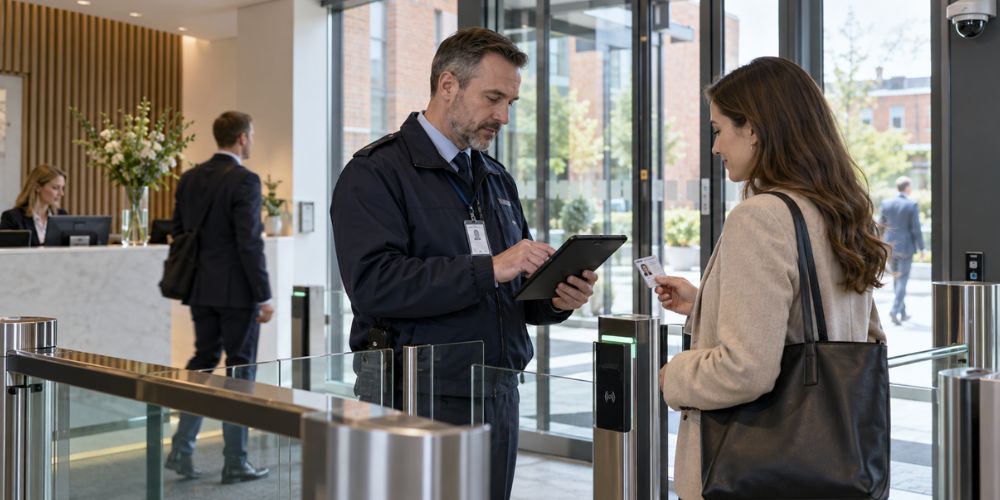
- Access control and visitor management: Verifying identities, issuing passes, and managing who enters and exits
- Perimeter and internal patrols: Regularly checking premises to identify vulnerabilities or suspicious activity
- Alarm response: Investigating and managing incidents when alerts are triggered
- Incident reporting: Maintaining accurate logs for legal and operational purposes
- Customer and visitor assistance: Acting as the first point of contact in offices, hotels, and retail environments
- Deterrence through presence: The visible deployment of uniformed personnel that discourages criminal activity before it starts
Manned guarding is used across a wide range of sectors: retail, construction, corporate offices, residential developments, hospitality, and live events.
What Falls Under Security Technology?
Security technology covers the full spectrum of electronic and automated systems designed to monitor, detect, and alert. Over the last decade, these systems have evolved dramatically — moving from passive recording devices to intelligent, AI-driven platforms.
Common security technologies deployed in commercial and industrial settings include:
- CCTV cameras with AI analytics: intelligent systems that detect movement, identify unusual behaviour, and generate automatic alerts
- Biometric and RFID access control: Fingerprint, facial recognition, or card-based entry management
- Intrusion detection systems: Motion sensors, pressure mats, and perimeter alarms
- Smart alarm platforms: Systems that send real-time notifications to mobile devices and monitoring centres
- Remote video monitoring: Off-site operators watching live feeds across multiple locations simultaneously
- Automated patrol drones: Used in large industrial or outdoor environments
The most significant shift has been technology’s move from reactive to proactive. Modern systems do not simply record what happened, they flag anomalies, predict patterns, and alert operators before an incident escalates.
Manned Guarding vs Security Technology
Understanding how each approach performs across key security dimensions is essential before making any investment decision.
Threat Deterrence
A uniformed security guard standing at an entrance sends a clear, unmistakable message: this premises is protected. Research consistently shows that visible human presence is one of the most effective deterrents to opportunistic crime.
Security technology offers a more passive form of deterrence. CCTV signage and camera housings can discourage some intruders, but a determined criminal who has assessed the location knows that a camera alone cannot physically stop them. The deterrent effect of technology is real — but weaker than that of a trained officer on-site.
Incident Response
When something goes wrong, speed and decisiveness matter. A security guard can assess the situation immediately, intervene physically if necessary, call emergency services, and manage the scene, all within seconds of an incident occurring.
Security technology, however well-designed, relies on alerts reaching a human who then has to respond. Whether that is a remote monitoring operator, a police unit, or an on-call manager, there is an inherent delay between detection and action. In high-risk environments, that gap can be critical.
Consistency and Reliability
This is where technology holds a clear edge. Electronic systems do not get tired. They do not lose focus during a quiet night shift, take a break at the wrong moment, or have an off day. A well-maintained CCTV or access control system will monitor your premises with exactly the same diligence at 3am on a Sunday as it does at 9am on a Monday.
Human performance, by contrast, is variable. Fatigue, stress, and the natural limits of attention can affect even the most professional guard over a long shift.
Evidence Collection and Data
If an incident leads to an insurance claim, disciplinary process, or criminal prosecution, evidence quality is everything. Security technology provides timestamped, high-definition footage, access logs, and digital audit trails all of which are admissible in legal proceedings and difficult to dispute.
Manual reporting by security guards, while valuable, is inherently subject to human memory and interpretation. It supplements the digital record but rarely replaces it.
Adaptability in Complex Situations
No algorithm fully accounts for the unpredictability of human behaviour. When a situation is ambiguous an agitated visitor, a suspicious interaction, an emerging crowd control issue, a trained guard can read the context, exercise judgment, and respond proportionately.
Security technology, regardless of how sophisticated, operates within the boundaries of what it has been programmed to detect and do. It performs reliably within known parameters; outside them, it often falls short.
Cost
Cost is one of the most decisive factors for most organisations. The honest breakdown is this:
- Manned Guarding: Carries higher ongoing operational costs, salaries, training, licensing, insurance, and shift cover all add up. For 24/7 coverage across multiple posts, the annual spend can be substantial.
- Security Technology: typically requires a higher upfront capital investment but tends to reduce long-term costs. Once installed and operational, systems require maintenance rather than ongoing labour costs at the same scale.
Neither option is inherently cheaper, it depends on coverage requirements, number of sites, and how the systems are structured. For many businesses, a hybrid model often delivers the best cost-to-protection ratio.
Which Solution Fits Your Situation?
Rather than prescribing a single answer, the right approach is to match the solution to the environment. Here is a practical guide:
| Situation | Recommended Approach |
| High-footfall retail store | Manned guarding + in-store CCTV |
| Remote industrial or construction site (unstaffed overnight) | Technology-first with mobile patrol response |
| Corporate headquarters with senior executives on-site | Hybrid: access control, CCTV, and dedicated guards |
| One-off event or temporary site | Manned guarding |
| Large warehouse or logistics facility (24/7 operations) | AI-monitored CCTV + security officers at key access points |
| Residential development | Concierge security + access control technology |
| Multi-site retail or commercial portfolio | Centralised remote monitoring + guards deployed to incidents |
The Case for a Hybrid Security Model
The question is rarely “manned guarding or technology.” For most organisations operating at any meaningful scale, the real answer is: both, working together.
A hybrid model layers human intelligence on top of technological infrastructure. Guards are supported by real-time feeds from cameras and sensors, allowing them to respond faster and more accurately to specific threats. AI analytics can flag anomalies to a human operator who can immediately assess whether an intervention is needed.
This integrated approach delivers:
- Wider Coverage: Technology monitors all areas continuously; guards focus their presence and response where it matters most
- Faster, more Informed Response: Officers arrive on scene already briefed by live footage
- Reduced Cost: Fewer guards are needed when technology handles monitoring, lowering overall operational expenditure
- Stronger Evidence: Digital records are backed by trained witness accounts
Leading security providers now design layered security architectures precisely because this integration outperforms either solution in isolation.
Even in an era of sophisticated automation, there are things that technology simply cannot do.
It cannot de-escalate a confrontation using tone of voice and body language. It cannot make a judgment call when a situation does not fit a pre-defined pattern. It cannot physically intervene to stop a theft, remove a trespasser, or assist someone in a medical emergency. And it cannot provide the reassurance of a visible human presence to staff, customers, and visitors who feel unsafe.
Security technology is a powerful force multiplier, but a guard who can act, think, and respond with emotional intelligence remains irreplaceable in any environment where people are present.
Conclusion
The debate between manned guarding and security technology is ultimately a false choice. Both have distinct strengths. Both have limitations. And used in isolation, both leave gaps.
The organisations with the most effective security postures are those that treat manned guarding and technology not as competing alternatives, but as complementary layers within a coherent security strategy.
The right balance depends on your specific risks, your site, your people, and your resources. A professional security assessment is the most reliable starting point mapping your vulnerabilities to the right combination of solutions, rather than defaulting to one size fits all.