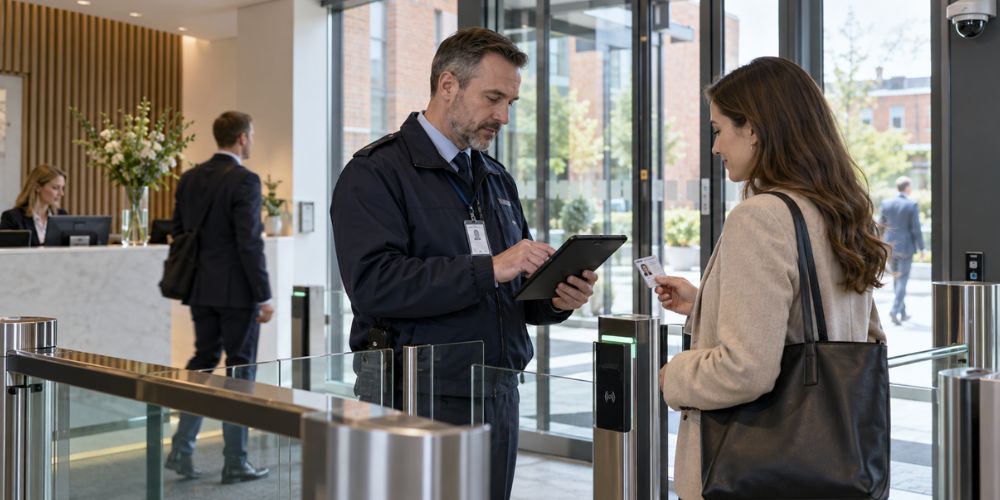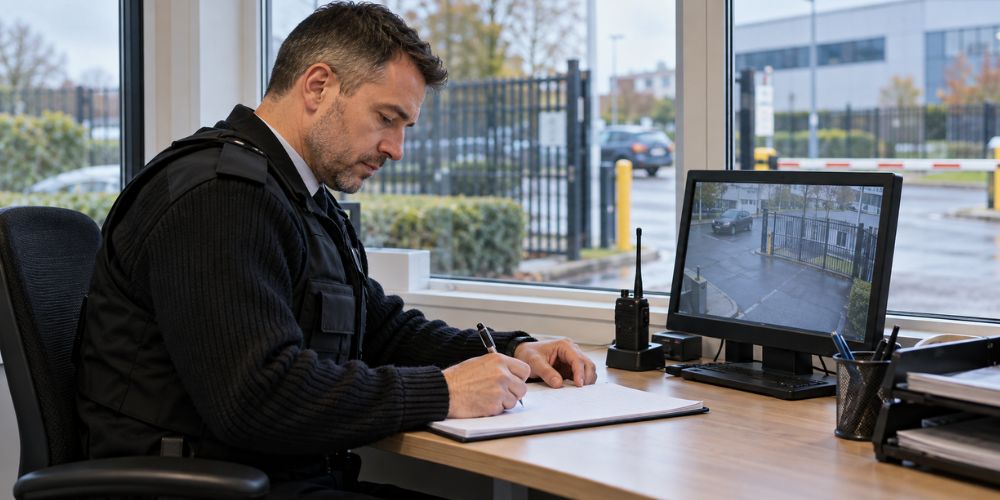
When it comes to protecting your business, your staff, and your assets, the decision about how you staff your security operation is one of the most consequential you will make. Most business owners approach it as a budget question. It is not. It is a strategic one.
The model you choose determines who carries legal liability when something goes wrong, how quickly you can scale up during a crisis, how deeply your guards understand your site, and whether your security operation runs smoothly or becomes a constant administrative burden.
This guide breaks down both models in full, direct hire and contracted security services, along with a third hybrid option that many businesses overlook. By the end, you will have a clear framework for making the right decision for your specific situation.
Direct Hire Security
When you directly hire security guards, they become your employees. You own the entire relationship, recruitment, vetting, training, payroll, scheduling, disciplinary processes, and legal compliance. The guards wear your brand, follow your protocols, and are fully integrated into your workforce.
This model is typically chosen by organisations with stable, long-term security needs at a single site, where deep familiarity with the location, staff, and operational procedures is essential. Think data centres, government buildings, financial institutions, or large corporate campuses.
Contracted Security Services
With contracted security, you engage a third-party security firm to supply, deploy, and manage guards on your behalf. The guards remain employees of the security company. You define the scope of cover, agree on service standards, and pay a monthly or hourly rate. The provider handles everything behind the scenes, payroll, insurance, licensing, and replacements.
This model suits businesses that need flexibility, fast deployment, multi-site cover, or simply do not have the internal HR capacity to manage a security team effectively.
True Cost Breakdown
Cost is almost always the first factor businesses consider. But the headline numbers are rarely the whole picture. Both models carry hidden costs that can significantly shift the financial calculus.
Direct Hire
When you hire security guards directly, the visible cost is salary. But the true cost is substantially higher once you account for employer national insurance or superannuation contributions, recruitment costs including job board fees and internal HR time, onboarding and site familiarisation, SIA licensing fees and renewals, ongoing training and refresher certifications, uniforms and equipment, sick pay and holiday entitlements, HR management time for performance reviews and disciplinaries, and premium agency day rates when your own guards are absent.
A single full-time security guard earning a modest salary can cost 30 to 40 percent more in total employment costs once all of the above are factored in. Many businesses discover this only after they have committed to the model.
Contracted Security
Contracted security rates look more expensive per hour than a direct hire salary. But those rates bundle in guard wages and employer contributions, vetting and background screening, management and supervision, liability insurance, sick cover and guard replacement at no extra charge, and ongoing training and compliance management.
The result is a single predictable monthly invoice with no administrative tail. For most small-to-medium businesses, this simplicity has significant operational and financial value.
The Long-Term Verdict on Cost
Direct hire becomes genuinely cost-effective only when your security needs are stable, long-term, and large enough to justify building proper internal HR and training infrastructure. For most businesses, contracted security offers a lower total cost of ownership once the true administrative burden is honestly factored in.
Compliance, Legal Risk and Liability
Security is a regulated industry. Guards must be licensed, vetted, and managed in line with employment law. How you staff your security function determines where legal risk sits, and the difference between the two models is significant.
Direct Hire: You Own the Liability
When guards are your employees, you are directly responsible for right-to-work checks and immigration compliance, criminal record and DBS checks, SIA licensing verification and renewal tracking, employment law compliance across contracts and working hours, guard conduct on site, and maintaining audit-ready documentation for all of the above.
Errors in any of these areas can result in fines, failed compliance audits, loss of contracts, or legal proceedings. Many businesses underestimate the complexity of running this correctly, particularly as regulations are updated.
Contracted Security: Shared but Not Absent Risk
With a contracted provider, the employment liability sits primarily with the security firm. They are responsible for ensuring guards are properly licensed, vetted, insured, and compliant. This removes a significant operational burden from your business.
However, you are not entirely risk-free. If a guard causes harm on your premises, claims can still be directed at you as the occupier. And if you choose a poorly run provider, their failures become your problem in practice even if not in law. Choosing the right provider is therefore not a minor consideration, it is a core part of your risk management.
Recruitment, Training and Guard Quality
The quality of your security operation depends almost entirely on the quality of the people you put on site. And finding, screening, and training good security guards is harder than most businesses expect.
Why Security Recruitment is Different
Security guards are not just a physical presence. They are the first responders in an emergency, the face of your organisation at the entrance, and the people who must make difficult judgement calls under pressure, often alone, at night, with no management backup. A standard CV review and interview process is not equipped to identify who will perform well in those moments.
Effective security recruitment requires scenario-based screening, situational judgement assessments, and careful role-to-site matching. A guard suited to a busy retail environment is not the same as one suited to a quiet corporate lobby or an active industrial facility.
The Direct Hire Challenge
Internal HR teams, even good ones, rarely have the security-specific expertise to screen candidates effectively. Common pitfalls include over-relying on SIA licensing as a proxy for capability, failing to conduct role-specific reference checks, poor site-matching that leads to early turnover, no structured training programme beyond basic induction, and no system for tracking certification renewals over time.
The result is often a revolving door of underperforming or short-tenured guards, which undermines the very continuity that direct hire is supposed to provide.
The Contracted and Agency Advantage
Reputable security providers maintain pre-screened pools of candidates. They use specialist recruitment methods, carry out thorough background checks as standard, and match guards to sites based on experience profile and behavioural suitability. Their training programmes are structured, regularly updated, and often exceed minimum regulatory requirements.
When a guard underperforms or leaves, replacement is managed by the provider — usually within 24 to 48 hours, with a replacement who has already been vetted and briefed on your site requirements.
Flexibility, Scalability and Continuity
Where Direct Hire Falls Short
Direct hire works well when your security needs are stable and predictable. It struggles with change. If you need to increase cover for an event, open a new site, or respond to a sudden security incident, the recruitment and onboarding cycle means you cannot respond quickly. A typical direct hire process, posting, interviews, checks, and onboarding, takes four to eight weeks at a minimum.
Sick leave and resignations also create immediate gaps that you must fill at premium agency day rates, which quietly erodes the cost advantage of the direct hire model over time.
Where Contracted Security Excels
Contracted security is built for flexibility. Providers maintain standby candidate pools specifically to handle surge demand, emergency cover, and rapid deployment. New sites can be staffed within days. Cover can be scaled down during quiet periods without redundancy costs. Multi-site operations can be managed under a single contract with one account manager.
For businesses that are growing, operating across multiple locations, or dealing with seasonal or event-based fluctuations in security demand, contracted security provides a level of agility that direct hire simply cannot match.
Operational Control and Guard Performance
Direct Hire: Maximum Control
The clearest advantage of direct hire is control. Guards follow your protocols, report to your management chain, and are subject to your disciplinary processes. Over time, they build deep familiarity with your site, your staff, and your operational patterns. Long-serving in-house guards often become an invaluable part of the fabric of a business.
If cultural integration matters, if you want security staff who feel genuinely part of your team, understand your values, and are invested in the organisation, direct hire is the stronger model.
Contracted Security: Control Through the Contract
With contracted security, your control is exercised indirectly through your service level agreement and your relationship with the provider’s account manager. This is not inherently weaker, but it requires that the contract is well-written and that you actively manage the relationship rather than treating it as a set-and-forget arrangement.
One common weakness is guard rotation. If the provider frequently changes which guards are assigned to your site, continuity suffers. Address this directly in your contract by requesting consistent assignment and including clear provisions for how guard changes are handled and communicated.
When Does Each Model Work Best?
Choose Direct Hire If
You operate a high-security or sensitive facility such as a data centre, government site, financial institution, or critical infrastructure. Your security needs are stable and long-term with no significant seasonal variation or planned expansion. You have strong internal HR, training, and management capacity to run the employment relationship correctly. Cultural integration, brand alignment, and guard loyalty are genuine operational priorities. And you have sufficient volume to justify proper internal training and compliance infrastructure.
Choose Contracted Security If
You need guards on site quickly, measured in days, not weeks. Your security demands fluctuate due to seasonal peaks, events, or multi-site operations. Your internal HR team lacks security-specific recruitment and compliance expertise. You want a single, predictable monthly cost with no hidden administrative burden. Or you are a small or medium-sized business without the infrastructure to manage a security team in-house.
Red Flags to Watch For
Warning Signs in a Contracted Provider
Be cautious of providers who offer vague or missing insurance coverage — a reputable firm can produce certificates on request. Watch for no clear process for removing or replacing underperforming guards, high guard turnover with no explanation or mitigation plan, SLA terms that use phrases like “best efforts” instead of measurable standards, unwillingness to provide references from similar clients, and no dedicated account manager or single point of contact.
Warning Signs in a Direct Hire Setup
Be alert to the absence of a structured training programme beyond basic induction, no process for tracking SIA license renewals or certification currency, no contingency plan for sick leave or resignation gaps, inconsistent background screening standards applied to different hires, and no formal performance management process in place for security staff.
Conclusion
There is no universally correct answer. The right security staffing model depends on your site, your risk profile, your internal capabilities, and your growth trajectory.
For most small and medium-sized businesses, contracted security is the smarter starting point. It delivers faster deployment, greater flexibility, reduced administrative burden, and a single predictable cost. The operational control you sacrifice is manageable with a well-written contract and an actively managed provider relationship.
For larger organisations with stable, long-term security requirements and strong internal HR capacity, direct hire can deliver tighter integration and long-term cost efficiency, provided the proper investment in training, compliance infrastructure, and management is made upfront and sustained.
Whichever model you choose, the most important step is to audit your current setup honestly against the framework in this guide. Security is too important a function to leave to inertia or assumptions about what appears cheapest on the surface.