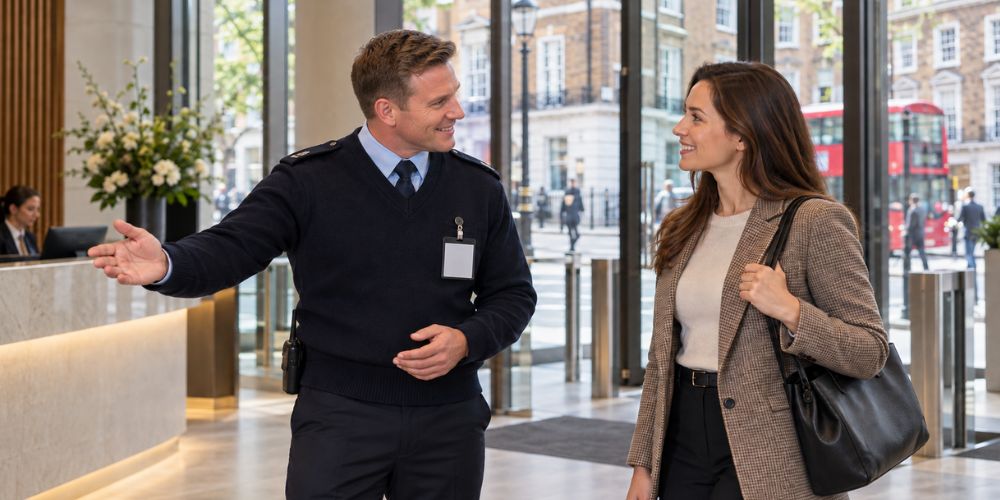
In most people’s minds, close protection security conjures a specific image, a towering figure in a dark suit standing behind a celebrity on a red carpet. It’s a picture shaped by films, tabloids, and television, and it misses almost everything important about what close protection actually is and who actually needs it.
Close protection isn’t about status. It isn’t a symbol of wealth or importance. It’s about understanding your threat environment clearly enough that a professional security detail becomes the logical, rational response. And in today’s world, where a single social media post can generate credible threats within hours, where senior executives face targeted harassment, and where high-net-worth individuals are increasingly visible online, that threshold is lower than most people realise.
This article covers what close protection security is, who genuinely needs it, and exactly what it delivers for the individuals and families who rely on it.
What is Close Protection Security?
Close protection, sometimes referred to as executive protection, involves providing personal security and risk management to individuals who may be exposed to threats as a direct result of who they are, what they do, or the position they hold.
It is fundamentally different from standard security work. A retail security officer manages an environment. A close protection officer manages a person, their movements, their exposure, their access points, and the risk attached to every place they go and every engagement they attend.
The role demands far more than physical presence. A professional close protection officer combines advanced situational awareness with meticulous planning, interpersonal skill, and the ability to make rapid decisions under pressure. They are not simply a physical barrier between a client and the outside world. They are a continuously operating risk management system, one that anticipates danger rather than simply reacting to it.
The most important thing a close protection officer does, in most cases, is the work that never becomes visible, because they identified and neutralised the problem before it reached their client.
Who Needs Close Protection?
The profile of a close protection client has broadened significantly over the past decade. While the role originated in diplomatic and governmental circles and then expanded into celebrity culture, the client base today spans a far wider range of individuals and professional contexts.
Corporate executives and chief executives of major organisations face threats that arise directly from their decisions, business rivals, disgruntled former employees, activist groups, or hostile media attention. Senior politicians and government officials operate in environments where public visibility and policy positions generate sustained hostility. Entertainers, musicians, actors, and athletes attract intense and sometimes obsessive public attention that can cross quickly from admiration into threat.
Increasingly, ultra-high-net-worth individuals and their families require protection, not because of their public roles, but because of their financial profile and the visibility that comes with it. And social media influencers with large, emotionally engaged audiences represent an entirely new category of client, individuals who are intensely public-facing without the traditional support structures that have historically come with celebrity.
The common thread is not fame or wealth in isolation. It is the combination of visibility, influence, or assets with a threat environment that makes personal safety a variable that cannot be left unmanaged.
Most individuals who genuinely need close protection delay engaging it for too long, not because they can’t afford it, but because they associate it with being ‘important enough’ to warrant it, rather than with a clear-eyed assessment of the risks that attach to their specific profile.
Why High-Profile Individuals Face Greater Risk
The threat landscape for high-profile individuals is real, varied, and evolving rapidly. Understanding it is the starting point for understanding why close protection exists.
Public visibility is the most obvious factor. The more visible a person is, the easier it is for unwanted attention to develop, for patterns to be observed, and for someone with harmful intent to build up a detailed picture of their target’s movements and routines. Social media has dramatically accelerated this, a person’s daily schedule, favourite locations, and social circles can often be reconstructed almost entirely from publicly available information.
Corporate and political tensions add another layer. Senior executives involved in high-stakes disputes, whistleblowing cases, or significant organisational change can face direct hostility from those affected by their decisions. Politicians operating in polarised environments face a heightened and documented risk of targeted threats. High-value assets, whether financial, intellectual, or physical, make individuals targets for theft, fraud, extortion, or kidnap for ransom, particularly when travelling internationally.
What has changed most significantly in recent years is the speed at which threats can develop. A controversial statement, a business dispute that becomes public, or even a viral media appearance can generate credible and organised threats within hours. The interval between exposure and risk is shorter than it has ever been, and organisations that do not have protective infrastructure in place are consistently caught unprepared.
The Core Benefits of Close Protection
Proactive Threat Management
The most important benefit of close protection is also the least visible one. Rather than waiting for an incident to occur and responding to it, professional close protection officers work continuously to identify emerging risks and neutralise them before they ever materialise into genuine danger.
This involves ongoing threat and risk assessment, monitoring of the client’s public profile and online exposure, intelligence gathering about known or potential adversaries, and the continuous evaluation of the environments the client moves through. The vast majority of incidents that never happen do so because a trained professional identified the conditions that would have allowed them to develop and intervened early.
Privacy and Controlled Access
A skilled close protection officer doesn’t simply protect the body, they manage access. They act as a discreet but firm buffer between the client and the outside world, ensuring that interactions occur on the client’s terms. Unwanted approaches, persistent media attention, and opportunistic individuals are handled efficiently and without drama, preserving both the client’s safety and their professional image.
This is particularly valuable for public figures who need to remain accessible and approachable in their professional roles while maintaining a clear and managed boundary around their personal safety.
Immediate Medical Response
Many close protection officers hold advanced first aid qualifications or emergency medical responder certifications. In the event of a medical emergency, whether a sudden health episode, a serious allergic reaction, or an injury following an incident, having a trained professional already present can make a decisive and irreversible difference to the outcome.
Emergency services response times vary enormously depending on location and circumstance. A close protection officer who is already present, already trained, and already familiar with the client’s medical history is a resource that no emergency response plan can fully replicate.
Advance Work and Route Planning
Before a client arrives anywhere, professional close protection teams conduct detailed advance reconnaissance. This means physically visiting venues, assessing entry and exit points, identifying vulnerabilities, establishing emergency protocols, liaising with local security teams and venue management, and ensuring that every location on the itinerary has been thoroughly evaluated for risk before the client sets foot in it.
This advance work is what separates reactive security from genuinely protective security. Problems are solved in planning, not in the field.
Psychological Freedom and Reduced Cognitive Load
One of the most significant, and least discussed, benefits of close protection is the mental relief it provides. Operating under a continuous background awareness of personal safety is cognitively exhausting. It diverts attention, generates anxiety, and imposes a constant low-level stress that affects decision-making, performance, and quality of life.
Knowing that a professional is continuously managing situational awareness allows a high-profile individual to direct their full attention to their work, their public engagements, and their personal relationships, without the weight of personal safety considerations permanently occupying part of their mind. Many clients describe this as transformative.
International Travel Security
When travelling abroad, particularly to unfamiliar regions, politically unstable environments, or locations with higher crime rates, the risks facing a high-profile individual increase significantly. Local knowledge, cultural context, and established relationships with vetted ground partners matter enormously.
Professional close protection teams provide in-country intelligence, vetted transportation, diplomatic liaison, secure accommodation assessment, and on-the-ground situational management that no travel application, hotel concierge, or standard travel insurance policy can come close to replicating. For executives travelling to high-risk regions for business, this capability is not a luxury, it is a fundamental operational requirement.
Close Protection and Corporate Security
For senior executives and corporate leaders, close protection rarely operates in isolation. It works alongside and within broader corporate security frameworks to provide smooth, consistent protection across both professional and personal contexts.
This includes secure travel arrangements for directors attending high-profile meetings or site visits, protective presence at shareholder meetings, product launches, or media appearances where public access creates vulnerability, and discreet security management at corporate events. It also extends, where required, to the protection of family members during periods of elevated risk, because threat does not respect the boundary between a person’s professional life and their front door. A credible adversary targeting a senior executive will frequently look for vulnerabilities in the person’s private life rather than their professional one.
Technology in Modern Close Protection
Modern close protection operations are supported by an expanding range of technological capabilities. GPS tracking systems allow teams to monitor the precise location of clients and vehicles in real time. Encrypted communication platforms ensure that sensitive operational information cannot be intercepted. Real-time intelligence feeds allow teams to monitor developing situations, a protest, a security incident, a change in local threat level, and adjust plans immediately.
Surveillance detection equipment, counter-drone capabilities, and digital security tools that protect against tracking and monitoring add further layers of protection. Technology does not replace the judgement and skill of a trained close protection officer, but it significantly extends their situational awareness and their ability to coordinate an effective response.
What to Look for in a Close Protection Provider
The quality of close protection providers varies enormously, and the consequences of choosing poorly are serious. Several standards separate genuinely professional firms from the rest.
All officers operating in a close protection role in the UK must hold a valid SIA Close Protection Licence. This is a legal requirement, not an optional credential, and any provider who cannot confirm the licensing status of their officers should be dismissed immediately. Beyond licensing, thorough background screening, identity verification, and character assessment of all personnel are non-negotiable foundations of any trustworthy security firm.
The quality of planning and intelligence work is equally important. A professional close protection provider will conduct a bespoke threat and risk assessment before deploying any resource, tailoring their security planning specifically to the individual’s risk profile, lifestyle, and itinerary. Generic, one-size-fits-all packages are a red flag.
Experience in the relevant domain matters. An executive requiring protection during international travel has different needs from a celebrity requiring event security or a family requiring residential protection. Providers with specific, demonstrable experience in the relevant context should always be preferred.
G3 FM delivers exactly that, fully SIA-licensed close protection officers, intelligence-led planning, and bespoke security tailored to each client’s risk profile across corporate, celebrity, and private client sectors.
Conclusion
The decision to engage close protection security is rarely taken lightly, and nor should it be. It represents a considered, intelligent response to a genuine set of risks, one that draws on professional expertise, continuous intelligence work, and a standard of planning and execution that is entirely different from general security provision.
What is consistently true, however, is that most clients do not engage close protection services after a thorough threat assessment. They engage them after an incident. An initial protective assessment and a well-structured security plan cost a fraction of the disruption, legal exposure, reputational damage, and personal trauma that follows a serious incident involving a high-profile individual or their family.
The best close protection, like the best security work of any kind, is defined entirely by what does not happen. The threats that are identified early and neutralised quietly. The incidents that never develop because the conditions for them were never allowed to form. The work that remains invisible because it succeeded.